





The 80/20 rule, or the Pareto Principle, is one of those rare concepts that feels like a cheat code for business efficiency. At its heart, it suggests a fascinating imbalance in the world: roughly 80% of your results come from just 20% of your efforts, whether you are looking at sales, web traffic, or even social dynamics, this rule pops up everywhere.
The outcome of embracing this principle is working less and smarter: by identifying few factors that drive the majority of your success, you can stop drowning in the trivial many. For an entrepreneur or for a manager, the friendly reality of Pareto Principle is clarity: it gives permission to prioritize the high-impact activities that actually move the needle, helping to transform a chaotic to-do list into a focused strategy for growth and sustainability.

Description and formulas
The principle is named after Vilfredo Pareto, an Italian economist and sociologist who observed that wealth and power were never distributed equally. His Theory of the élites noted that societies are naturally divided into a minority of Governors and a majority of Governed. This observation of social heterogeneity and inequality evolved into a statistical rule found in almost all complex systems of cause and effect.
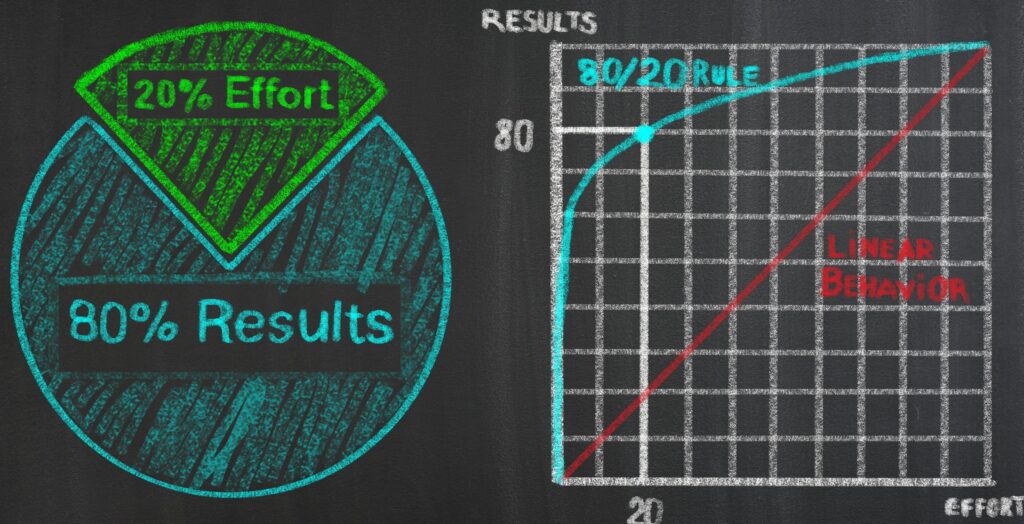
The rule states that 20% of causes produce 80% of effects, while the remaining 80% of causes account for only 20% of the results. It is important to note that 80/20 are symbolic and approximate: in reality, the split might be 70/30 or 90/10. However, the core message remains: variables are almost never distributed linearly.
A perfect visual representation of this is the Pareto Diagram or, in modern business, the Marketing Funnel:
At the top, a massive number of people who barely know your Brand (80% of causes with low engagement). As moving down, the number of people decreases as engagement increases. At the very bottom, the Super-Clients: the 20% who actually convert, buy, and generate the bulk of your revenue.
While Pareto Principle is a qualitative guide, it can be expressed through the logic of cumulative distribution. If we rank causes (products, customers, or tasks) by their effect (profit, time, or sales), we find a non-linear relationship:
E = f(C)
Where E (Effect) is heavily concentrated in a small subset of C (Causes). In a marketing context, if R is total revenue and n is the number of customers:
Revenue from top 20% of n customers ≈ 0.80 x R
This creates a Power Law distribution rather than a Standard Bell curve. In content creation, for instance, a writer might find that 20% of their articles generate 80% of their site traffic, while the rest are barely indexed by search engines. This isn’t a failure of the other 80%; it is simply the statistical nature of engagement in a competitive digital ecosystem.
Main use
The primary use of the 80/20 rule is strategic prioritization and risk management. In marketing, it helps identify which campaigns or Super-Clients deserve the most resources.
A sophisticated analysis warns against a common trap: eliminating the bottom 80% of activities just because they seem unproductive. In reality, those 80% of activities are often propedeutic: they are the necessary foundation that cultivates the 20% of high-performers. Without the broad reach of the top of the funnel, you would never find the élite customers at the bottom. Furthermore, relying only on the top 20% creates a Giant with feet of clay: if a business has only one or two massive clients representing 80% of its turnover, it is incredibly vulnerable.
Therefore, the 80/20 rule is best used to:
- Allocate resources: Invest more time and “white-glove” service into the top 20%.
- Optimize the Funnel: Improve the conversion rate so that the 20% becomes more profitable.
- Manage Risk: Ensure that even being focus on the élite, an healthy base avoids the over-dependence on a few sources of income.