





Simple and powerful way to “take a picture” of a company’s situation at a specific moment. Instead of starting from complex financial indicators or long reports, SWOT invites to pause and ask four clear questions: what are we good at, where are we weak, what chances are opening up in the market, and what risks could hurt us?
By the end of a good SWOT exercise, managers and entrepreneurs have a shared, transparent view of reality. Confusion is reduced, priorities become clearer, and it is easier to connect strategic ideas with everyday decisions: SWOT becomes a bridge between numbers (like EBIT or EBITDA) and concrete choices on products, customers, investments, and internal organization.

Description and formulas
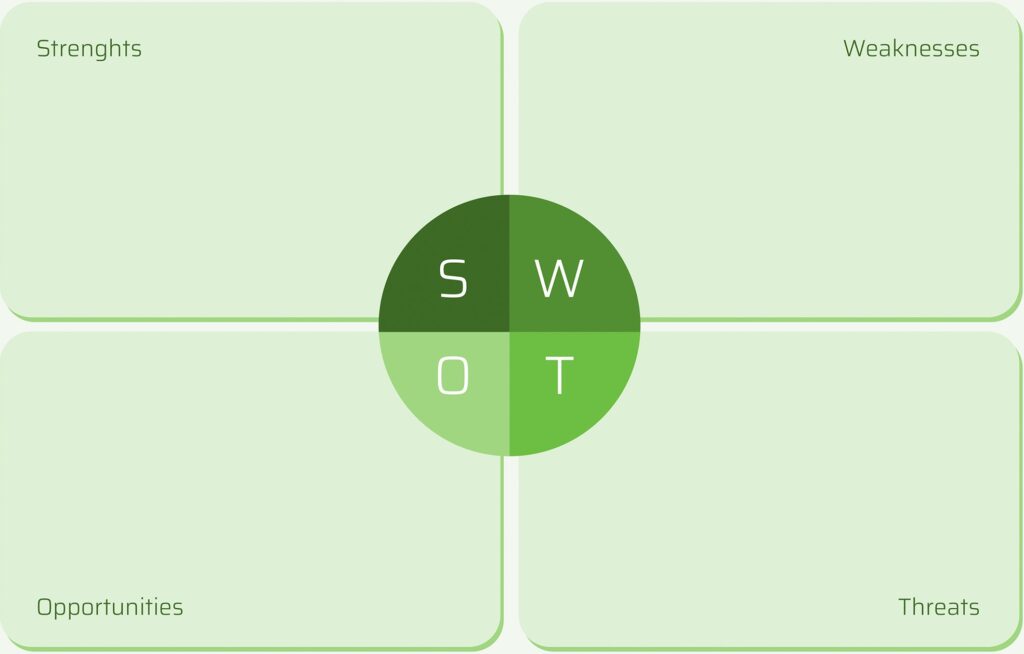
In business practice, SWOT is a structured framework that classifies key factors into four groups: Strengths, Weaknesses, Opportunities, Threats, and represented as a 2×2 matrix. Even if it is not a “formula” in the mathematical sense, its strength lies in how it organizes information and guides reasoning.
At the top of the matrix internal factors are placed, those that depend mainly on the company and its management:
- Strengths: what the Company does particularly well, such as: recognized brands, strong technical know‑how, efficient processes, loyal customers, healthy profitability, or a solid capital structure. These elements support competitiveness and help generate value and income over time.
- Weaknesses: the structural limits that reduce performances: they may be high operating costs, obsolete technology, dependence on few clients, organizational rigidity, or lack of managerial skills. Weaknesses slow growth and make the firm more fragile when the environment changes.
At the bottom of the matrix external factors are placed, linked to the market and the broader context:
- Opportunities: favorable trends that the company could exploit: new market segments, technological innovations, regulatory changes, or partnerships that can be activated all fall into this area. They are not yet actual results, but potential value to be captured through appropriate strategies and investments.
- Threats: external forces that may damage revenues, margins, or the competitive position. Examples are new aggressive competitors, changes in customer preferences, economic crises, higher interest rates, or unfavorable regulations. The company cannot control threats, but it can prepare and mitigate their impact.
From a “formula” perspective, SWOT is about a logical combination of these four dimensions. A simple way to represent the strategic logic is:
- Growth strategies: Leverage Strengths +Exploit Opportunities
- Defensive strategies: Limit Weaknesses +Protect from Threats
In practice, the analysis proceeds in three steps. First, data are collected: performance indicators (like revenue, margins, EBIT, EBITDA), market research, customer feedback, and internal assessments of processes and skills. Second, these elements are classified in the four quadrants through workshops and discussions, aiming for realism rather than wishful thinking. Third, management derives a small number of strategic priorities: where to invest, what to fix, what to stop doing, and which risks to monitor closely.
The real value of SWOT does not lie only in the matrix itself, but in the clarity it brings to the link between internal capabilities, external context, and future strategic choices.
Main use
It’s a decision‑support tool in strategic and business planning and one of the first steps in drafting a business plan, evaluating a new project, entering a new market, or reviewing a company’s medium‑term strategy.
In day‑to‑day management, SWOT helps align top management, middle managers, and sometimes even key employees around a shared view of reality. It translates complex information – financial results, operational performance, market signals – into a narrative that everyone can understand: where we are strong, where we must improve, what the market is offering us, and what could undermine our results if we do nothing.
Combined with quantitative indicators (such as profitability ratios, cash flow measures or leverage ratios), SWOT allows a more complete evaluation of the health and potential of the business. It becomes a practical guide for choosing which initiatives to launch, which investments to prioritize, and which risks to accept, transfer, or reduce. In this sense, SWOT is not just an academic tool, but a living framework that supports concrete managerial action.