





It’s a simple tool with a powerful outcome: it helps to understand how strangers become customers, step by step. Instead of seeing marketing as a collection of disconnected actions (ads, social posts, emails) the funnel turns the customer journey into a clear path. At the top, many people notice the Brand for the first time; at the bottom, a smaller group makes a decision that matters for the business, such as a purchase or a subscription.
The friendly promise of Marketing Funnel is clarity: it shows where attention is lost, where trust is built, and where value is finally exchanged. For managers and entrepreneurs, the outcome is more sales and, mainly, better decisions: knowing where to invest time, budget, and creativity in order to move people forward rather than simply doing more marketing.

Description and formulas
Conceptually, a Marketing Funnel is a visual and analytical model that represents the progressive reduction of prospects as engagement increases. It is typically drawn as an inverted pyramid because the number of people decreases while the quality of the relationship increases.
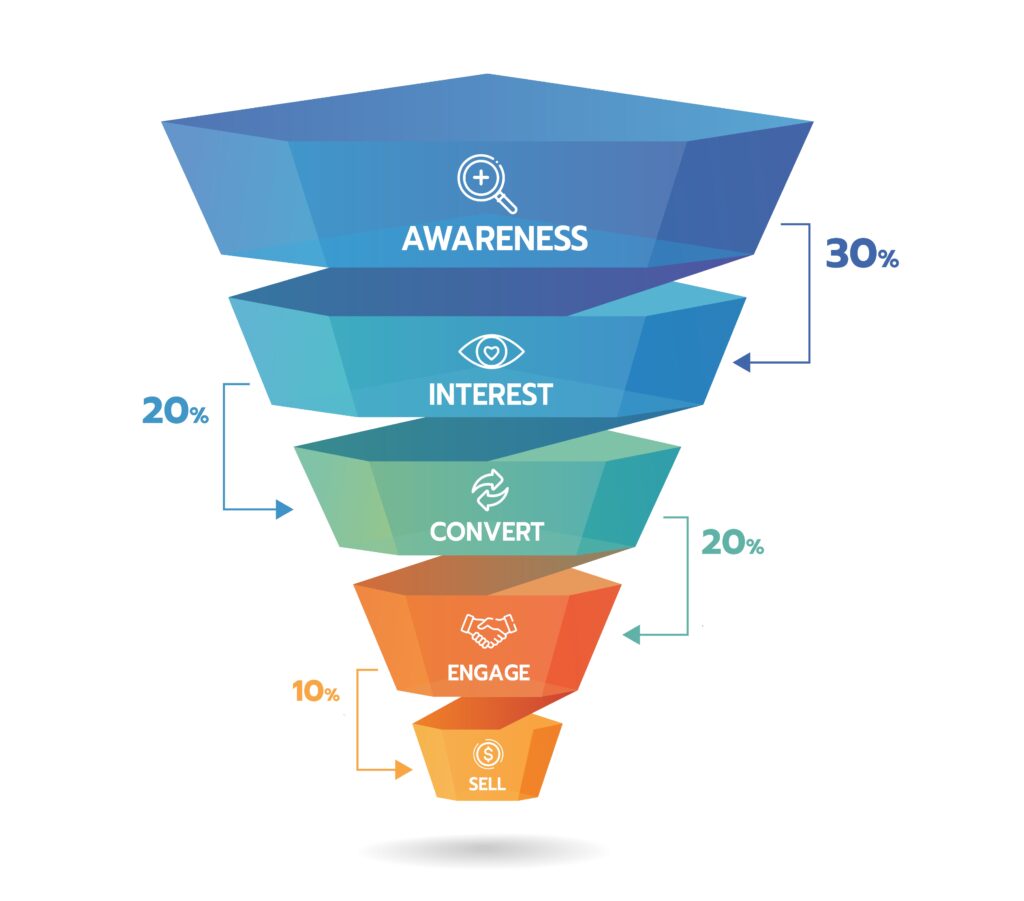
Steps and terminology can vary, but basically a Funnel shows as follows:
- Awareness: Potential customers become aware of the Brand or product through advertising, contents on social media, …
- Interest: A smaller group actively engages: visiting the website, reading content, watching videos, or comparing alternatives.
- Conversion: Prospects perform a key action: request a quote, sign up, or download informations.
- Engage (often placed as a post-sell stage): Existing customers are nurtured to repeat purchases and advocacy.
- Sell: The target is achieved, products are sold, services are bought, files of interest are downloaded
At each stage, some users drop out: this is not a failure but a structural characteristic of human attention and choice.
The funnel is strongly connected to the Pareto (80/20) Principle: a minority of users often generates the majority of revenue. Many people interact lightly with the Brand, but only a small percentage reaches high commitment. The Funnel makes this imbalance measurable, let:
N0 = number of people at the top of the funnel (awareness)
Ni = number of people at stage i
CRi = conversion rate from stage i to i+1
Then: Ni+1 =Ni × CRi
As example, if 10,000 users (N0) see an ad, 30% visit the website, 20% ask for an offer, 20% decide to continue and 10% of those buy, we have:
N1 =N0 xCR0 =10.000 ×0.30 =3.000
N2 =N1 xCR1 =3.000 ×0.20 =600
N3 =N2 xCR2 =600 ×0.20 =120
N4 =N3 xCR3 =120 ×0.10 =12
Each stage is monitored through specific indicators:
- Reach and impressions at the top
- Engagement rates (click-through rate, time on page) in the middle
- Conversion rate and cost per acquisition at the bottom
Revenue impact can be expressed as:
Revenue = N0 ×CR0 ×CR1 ×CR2 ×CR3 ×Average Order Value
This formula explains why marketing optimization focuses on getting more traffic and on improving flow efficiency between stages. Small improvements matter: increasing a single conversion rate has a multiplicative effect on final results.
Funnels are not static: users may move back and forth between stages, interact through multiple channels, or skip steps entirely. Digital tools allow businesses to update funnel assumptions in real time, adapting content, pricing, or messaging based on observed behavior.
Main use
Marketing Funnel controls and optimizes growth, it helps companies identifying where value is created and where it is lost: instead of guessing why sales are low, managers can see whether the issue lies in visibility, engagement, trust, or conversion.
Marketing Funnel is used to:
- Allocate marketing budgets more effectively, investing in stages with the highest leverage.
- Improve customer experience, by delivering the right message at the right moment.
- Forecast results, estimating sales based on traffic and conversion assumptions.
- Reduce risk, avoiding dependence on a single channel or campaign.
In this way marketing actions align with business strategy: Marketing Funnel transforms customer behavior into measurable steps, allowing teams to move from intuition to informed decision-making.